

Evidence Score: A
Score: 19/20 95%
Date Discovered: 5/5
The supposed anachronism was first challenged in 1973 by Hugh Nibley referencing a recently published Book by Yigael Yadin and the Bar-Kokhba documents discovered the previous decade.
While criticisms of this name do not seem to occur until 1910, it is a detail that Joseph or his contemporaries would not have known in 1829.
Claims of nineteenth century masculine use of the name are vastly overstated and it has been demonstrated that before publication of the Book of Mormon, English use of the name Alma was overwhelmingly, if not exclusively, feminine.
Biblical support: N/A
Alma does not occur within the Bible as a name. Almah occurs within the Hebrew meaning young woman or virgin. Discoveries of the 21st century however prove that as a name it’s use is not expressly feminine.
Archeological support: 5/5
Since 1961 multiple documents in Semitic languages have been discovered with the name Alma used in a masculine context, demonstrating that during the period in which the Book of Mormon claims to occur, Alma was a perfectly appropriate male name.
Scholarly Collaboration: 4/5
With so many artifacts dating to the first and second temple period directly identifying Alma as a man’s name, it would be difficult to find an intellectually honest scholar insisting otherwise.
There remain however no shortage of critics, likely ignorant of these many attestations who continue to claim that Alma cannot be a masculine name within Semitic languages.
Correlation to Text: 5/5
Artifacts attesting “Alma son of” definitively prove that Alma was used as a male name in Hebrew and other Semitic languages at the time Lehi left Jerusalem.
A common criticism of the Book of Mormon is its use of the name Alma, for some this is seen as low hanging fruit, an easy target and evidence of the absurdity of the Book of Mormon. These modern critics however, seem to be completely unaware that archaeological discoveries made over 50 years ago have completely vindicated this apparent anachronism.
Perceived Latin Origin
The earliest published criticism of the name Alma within the Book of Mormon seems to be what was written by Charles A. Shook in 1910, he stated simply “Alma, the name of one of the Nephite judges, is the Latin word for ‘benign.’”.1 He seems to be implying that because Alma is a Latin word, it cannot be a Semitic name. This assertion however, is not only an oversimplification, it demonstrates his lack of understanding regarding the topic about which he is writing. The true Latin definition of Alma is indeed feminine, however, rather than “benign” as Shook implies, it instead refers to: “providing nurturing, fostering, or a kindly mother.”2 In Latin, this word is part of our common language, with the phrase “Alma mater” meaning nourishing mother.
Since that time critics have rightfully understood the error of Shook’s translation and continued with the assumption that Joseph Smith simply borrowed the Latin word. However, this remains an oversimplification.
The Feminine usage of Alma
Far more common in recent decades is another attack against the name, the suggestion that the word or name can only be feminine. The word Alma, spelled עַלְמָה does in fact occur within the Old Testament of the Bible, (pay attention to the spelling, it’s important) in fact, there are seven occurrences of the word עַלְמָה, from a strictly biblical perspective, it would not make sense to name a male character עַלְמָה because as one critic asserted: “In Hebrew Alma means a betrothed virgin maiden—hardly a fitting name for a man.”3
In some Latin languages the name Alma has indeed come into use as a proper name, in Spanish speaking countries, where alma means “soul” it has grown quite popular. In the Spanish language of course the suffix of “a” definitively designates the word and name as feminine.
The critic would well to ask themselves why a 19th century author would choose to use a name, traditionally understood to be feminine, to give to not only one, but two of the masculine heroes of his book.
Archeological Discoveries
Many critics remain seemingly unaware that the landscape of this debate shifted dramatically in 1961, when renowned archaeologist Yigael Yadin made a groundbreaking discovery.4
During an excavation in Jerusalem, Yadin unearthed a leather bag filled with documents dating back to the early second century AD – a timeframe coinciding with the Book of Mormon’s historical setting.
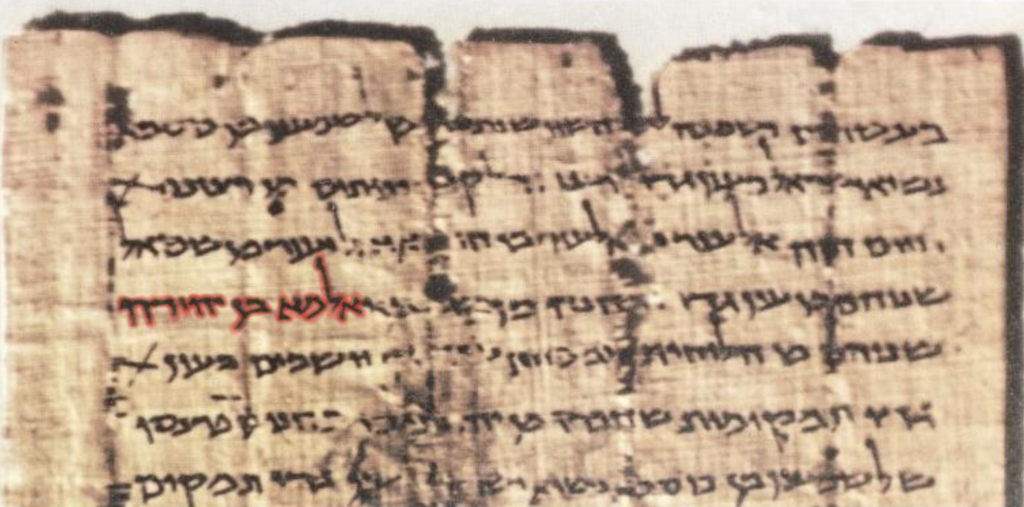
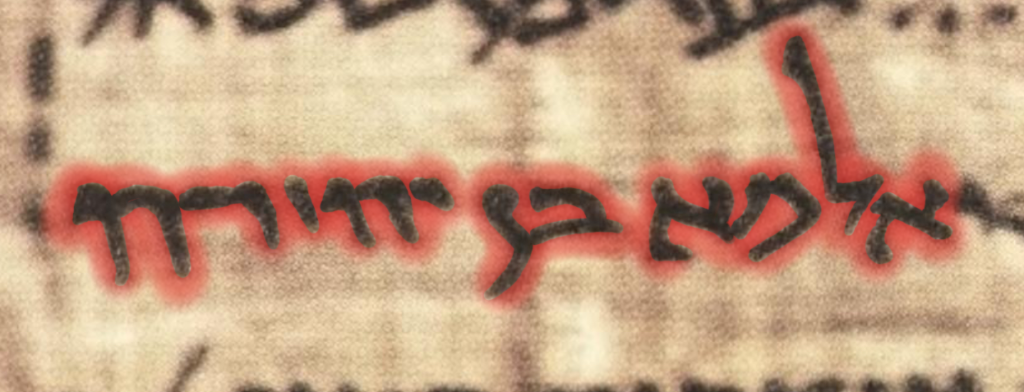
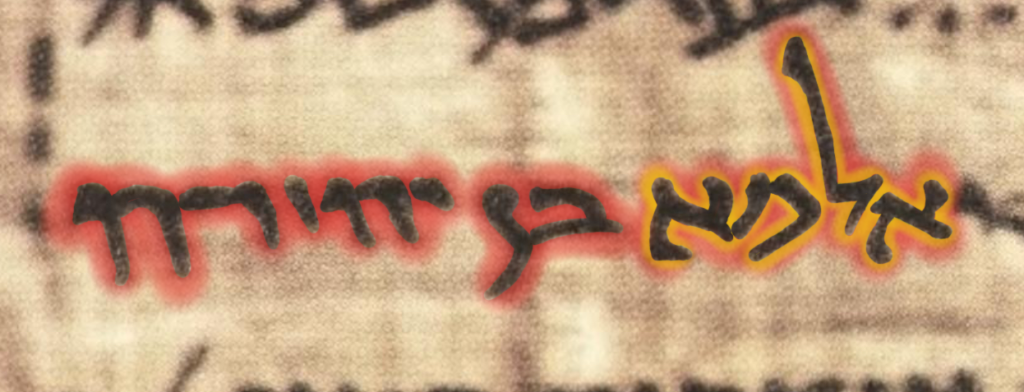
The truly captivating aspect of this find was one of the signatures which occurred twice on a deed among the documents: אלמא בן יהודה “Alma ben Yehuda.” This Hebrew phrase translates to “Alma, son of Judah,” definitively establishing Alma as a legitimate male name in ancient Hebrew culture.5 This discovery not only aligns with the Book of Mormon’s usage but also provides a compelling counterpoint to previous criticisms.
It is worth noting that the Alma used as a proper name here is spelled אלמא compared to the biblical and feminine עלמא, these two words are pronounced similarly, while one refers to young women or virgins, the other seems to translate to “a young man of God”6
Latter Day Saint scholars remained seemingly unaware of this discovery for a full decade, until Hugh Nibley remarked in 1971 in a review of Yadin’s book:
“it is … gratifying to announce … a deed to some land near engedi en gedi … and there at the end of the fourth line from the top as large as life is Alma ben Yehudah which prof. Yadin sensibly renders alma with no reservations.”7
While “Alma ben Juhudah” was the first attestation of the male name in Ancient Semitic languages, it would not be the last. In Eblah, six documents were discovered containing eight attestations of the name Alma dating to the end of the third millennium BC.8 One attestation refers to an Alma being among “merchants of Mari”. Another refers to “Alma of Mari” giving a gift of silver. Another mentions Alma giving silver, while three others mention Alma receiving silver. Finally two others mention Alma giving other gifts. It is unclear whether this is one man named Alma living in Mari or if there are multiple individuals, however, the administrative nature of the documents strongly indicates that this individual or individuals, are male.
It’s worth noting that while modern internet searches might yield numerous instances of Alma as a male name, this information would not have been readily available to Joseph Smith, the founder of the Latter-day Saint movement, in the early 19th century.9
Possible Masculine use in 19th century New York
Recently, critical accounts have attempted to move the goalpost and attempted to prove that Alma may have been recognized as a man’s name during the 19th century, claiming that as many as 42 men in the state of New York had the name Alma during Joseph’s day.10
However, further research demonstrated that 38 of these 42 individuals have confirmed to have been misgendered.11
Of the four remaining individuals, three of them were not actually named Alma, a Mr. Johnson living in South Bristol, New York in 1865 for example, has been mis-transcribed, his name being Alva Johnson and not Alma Johnson12.

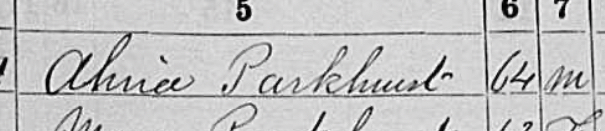
Similarly, an “Alma” Parkhurst living in Mendon, New York in 1875 was also mis-transcribed, his name in fact appearing to be Ahira Parkhurst.13
A Mr. Frary is listed as living in New York in 1870 with his name recorded as “Alma”.14 Seven historical records have been identified referencing Mr. Frary,15 with the exception of the 1870 census, each of these list the same Mr. Frary with the names Almon or Almond. It is unclear whether the census recorder misheard or intentionally shortened his name in the 1870 census. Both this individuals birth records, and gravestone bear the name Almon Frary. Leaving little doubt this was in fact his given name. Almon Frary’s grave can be found in the Colosse Cemetery in New York.16

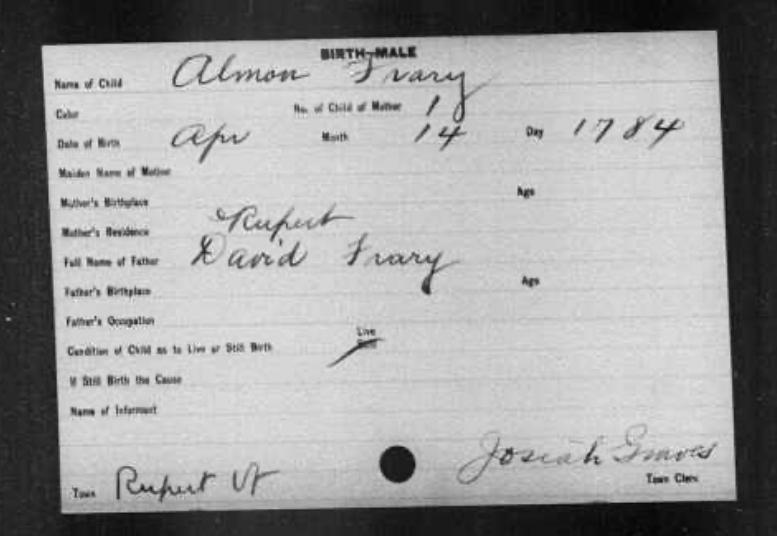
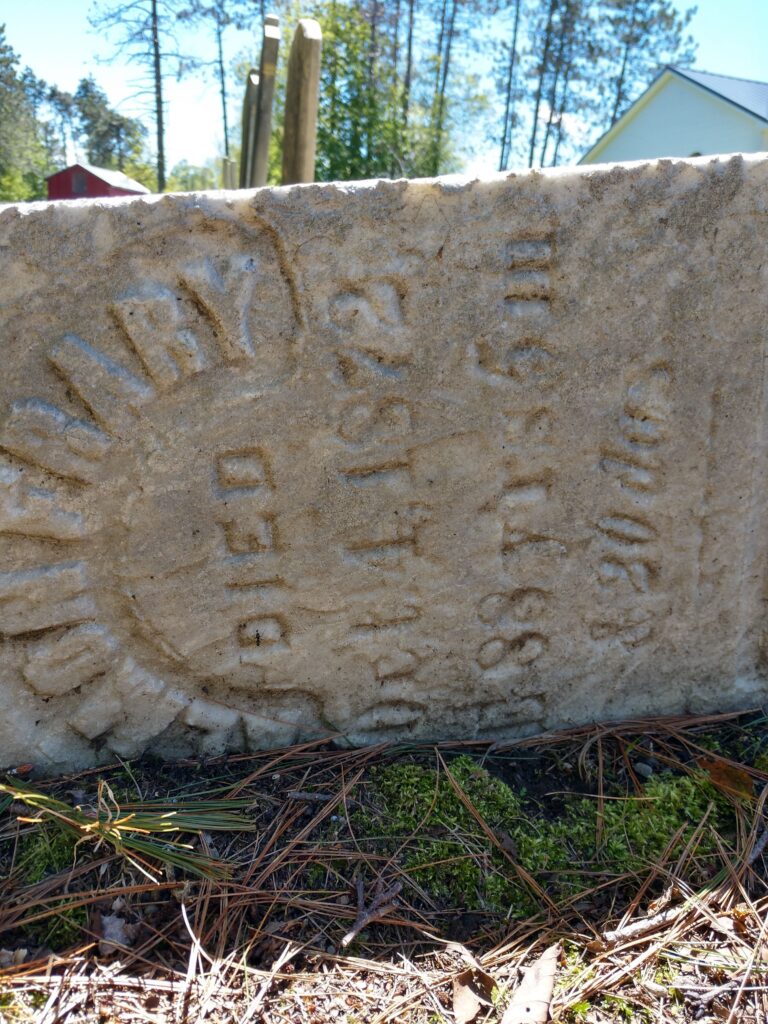
There is one case in which a man born prior to 1830 does appear to be named Alma. Such is the case of young Alma Pratt, born in 1817 on the Isle of Man in the Irish Sea. While Mr. Pratt did in fact live Rochester, New York in 1870,17 it unknown whether or not his immigration occurred before or after the publication of the Book of Mormon. No other records aside from the 1870 census have been identified for this individual. If Mr. Pratt did reside in New York in 1830, it appears he would be the only man in the entire state with the name of Alma.

Ultimately, of 42 instances, only one has the potential to actually be a man with the name Alma, however, too little is known of this individual and the records are unclear whether or not he even lived in the United States in 1830. Meaning that no, there is not a single provable attestation of Alma being used as a masculine name in upstate New York prior to the publication of the Book of Mormon. If anything, this information further demonstrates that if the name Alma was used at all as a masculine name in New York, prior to the Book of Mormon, it was only in extremely rare circumstances.
It is undeniable that Joseph Smith, or any of his contemporaries, if they where familiar with the name Alma at all, prior to the forthcoming of the Book of Mormon, they would have undoubtedly recognized it as a feminine name. Making it extremely improbable, if the Book of Mormon were a fabrication, that they would choose instead to use it as a masculine name when naming two of the most prominent heroes within the text.
Conclusion
The name Alma has proven to be both Semitic and masculine. It’s masculine use in Semitic languages, including Hebrew, predates Lehi’s exodus from the Holy Land. Joseph Smith, or his contemporaries, could not have known of these discoveries which would begin over a century after the publication of the Book of Mormon. Attempts to demonstrate masculine use of the name prior to the Book of Mormon have been extremely overstated and pay little attention to the actual historical data. In conclusion, the discovery of the name Alma as an Ancient Semitic male name is strong evidence for the historicity of the Book of Mormon. What was once considered anachronistic has now been proven synchronistic.


- Shook, Charles A. 1910. Cumorah Revisited. Cincinnati, OH: Standard Publishing Company.
- Oxford Latin Dictionary. 1968. Oxford: Oxford University Press, 105.
- Martin, W. (1986). The Maze of Mormonism. Regal Books, 327.
- Yadin, Yigael. “The Expedition to the Judean Desert.” Israel Exploration Journal, vol. 12, no. 3/4, 1961 (1962), pp. 227-257 (37 pages), https://www.jstor.org/stable/27924911
- Matthew Roper, “Right on Target: Boomerang Hits and the Book of Mormon,” FAIR Presentation, 2001.
- https://onoma.lib.byu.edu/index.php?title=ALMA
- Nibley, Hugh. (1974) “Review of Bar-Kochba by Zigael Yadin.” BYU Studies Quarterly 14, no. 1, Article 12
- Alma at Ebla
- Callister, T. R. (2019). A case for The book of mormon. Deseret Book.
- This claim appears to be first addressed by Daniel Peterson in 2019, with more research done by Neal Rappleye in 2024 (see note 11) https://latterdaysaintmag.com/does-the-name-alma-challenge-the-historicity-of-the-book-of-mormon/
- Rappleye, Neal, and Allen Hansen. 2024. “More Evidence for Alma as a Semitic Name.” Interpreter: A Journal of Latter-day Saint Faith and Scholarship 62: 415–428.
- 1865 New York State Census, Population Schedule, South Bristol, Ontario Co. (Albany, NY: New York State Archives), accessed at https://www.familysearch.org/ark:/61903/3:1:S3HT-6LNS-5KF?view=index&personArk=%2Fark%3A%2F61903%2F1%3A1%3AQVNN-DQ8R&action=view&cc=1491284
- 1875 New York State Census, Population Schedule, Mendon, Mendon Co. (Albany, NY: New York State Archives) accessed at https://www.familysearch.org/ark:/61903/3:1:S3HT-6DMS-3H2?view=index&personArk=%2Fark%3A%2F61903%2F1%3A1%3AVT89-KQB&action=view&cc=1918735
- US Census Bureau, 1870 United States Federal Census, Population Schedule, Mexico, Oswego Co., NY (Washington, DC: National Archives and Records Administration) accessed at https://www.familysearch.org/ark:/61903/3:1:S3HY-DTD9-TRS?view=index&personArk=%2Fark%3A%2F61903%2F1%3A1%3AM8VL-C93&action=view&cc=1438024
- https://www.familysearch.org/tree/person/sources/GSQZ-CS9
- https://www.findagrave.com/memorial/20138298/almon-frary for readability a photo of the gravestone on the ground was selected, it appears the gravestone has since been righted and repaired.
- https://www.familysearch.org/ark:/61903/3:1:S3HT-DTJ9-4ZS?view=index&personArk=%2Fark%3A%2F61903%2F1%3A1%3AM8JH-C8L&action=view&cc=1438024
A facsimile of the Bar Kochba letter featuring the name Alma as a male name is available for purchase from Biblical reproductions: https://www.biblicalreproductions.com/product/the-bar-kochba-letter-5-6hev-44-bar-kokhba/