

Son of King Zedekiah
Evidence Score: B-
Score: 20/25
Date discovered: 4/5
In 1970, Yohan Anharoni (Non-LDS Israeli scholar) first identified the biblical Malchiah (Jeremiah 38:6) as the son of King Zedekiah based on an incomplete translation of the KJV
In 1986, Hugh Nibley identified the use of Mulek as a Hebrew name MLK and a familial form of Malchiah
While these observations are recent, they do not challenge previous historical assumptions held in 1829
Biblical support: 4/5
Jeremiah 38:6 mentions a Malchiah son of Hammelech, more properly translated as Malchiah, son of the King. The context of the chapter makes it clear this is King Zedekiah. Malchiah is the son of King Zedekiah. The root of Malchiah is MLK, which can be pronounced Mulek. The removed of the YH suffix is not uncommon in Hebrew familial names
Evidence of these shortened familial names can be found throughout the Hebrew Old Testament with examples including Jeremiah and Elijah.
It is likely the Malchiah of the Old Testament is the same Mulek of the Book of Mormon, however, as no example of a familial form of Malachiah is found within the Bible, the Biblical evidence remains strong yet slightly speculative.
Archeological support: 4/5
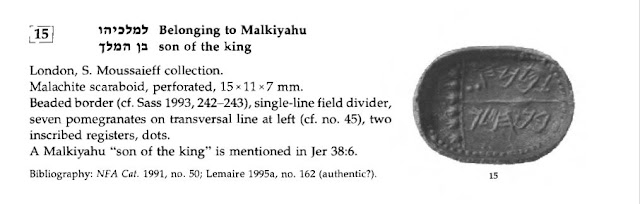
A stone stamp seal bearing the title “Malkiyahu son of the King” has been found dating to about 600 BC, confirming the existence and status of the Biblical figure. It is likely this once belonged to the same Mulek of the Book of Mormon
Until an artifact, or artifacts are found attesting the ancient shortening of MLKYH to MLK as a familiar form are found some speculation is requires, leaving the archeological evidence for Mulek as a son of King Zedekiah as strong, but still somewhat speculative.
Scholarly Collaboration: 3/5
It has become well accepted that Malkiyahu was one of the sons of King Zedekiah, however the connection of Malkiyahu and Mulek remains a topic of debate among secular and faithful scholars alike.
Some respected non-LDS scholars have acknowledged that Mulek is indeed a plausible form a name held by one of the sons of king Zedekiah.
It is possible that opinions on the matter are clouded by either bias or an over abundance of caution, however, opinions on the strength of this evidence among the academic community remain mixed.
Correlation to Text: 5/5
Mulek is the historical founder of the Mulekite nation within the Book of Mormon, if the connection between Mulek, son f King Zedekiah and Melkiyahu, son of the King, can be proven, the seal of Melkiyahu will have been the first artifact found bearing the name of, and anciently belonging to, a Book of Mormon figure.
See All Sources for Mulek within the Database
Now the land south was called Lehi, and the land north was called Mulek, which was after the son of Zedekiah; for the Lord did bring Mulek into the land north, and Lehi into the land south.
(Helaman 6:10)
The Book of Mormon boldly claims that the historical and biblical King Zedekiah had a son named Mulek. According to the text, this son escaped Jerusalem at the time of it’s destruction by the Babylonians.
The Fate of King Zedekiah’s Sons
A cursory reading of the Old Testament gives little detail regarding the sons of Zedekiah, save a detail in the accounts detailing the pillaging and destruction which occurred in 586 BC.
“And they slew the sons of Zedekiah before his eyes”
(2 Kings 25:7)
The Book of Mormon acknowledges this murder of the kings sons, but states that not ALL of the Zedekiah’s sons were killed.
And now will you dispute that Jerusalem was destroyed? Will ye say that the sons of Zedekiah were not slain, all except it were Mulek?
(Helaman 8:21)
Critics of the church have claimed that this contradicts the Biblical record, which they claim does not allow for a son of Zedekiah to have escaped.
Origen Bacholer wrote in 1838 “the Bible makes no exception, and therefore holds out the idea that they were all slain.”
However, none of the accounts including this detail state that ALL the sons of King Zedekiah were slain, in fact a reading of the entirety of these chapters almost would imply the opposite.
In historical accounts it is not uncommon to overstate or exaggerate the details. In chapter 25 of 2 Kings we read that:
- Nebedkunezer came with “ALL his host” (2 Kings 25:1)
- “ALL the men of war fled” (2 Kings 25:4)
- “ALL his army were scattered” (2 Kings 25:5)
- “he burnt the house of the Lord, and the king’s house, and ALL the houses of Jerusalem” (2 Kings 25:9)
- “ALL the vessels of brass” were taken (2 kings 25:14)
- They “brake down ALL the walls of Jerusalem” (Jeremiah 52:14)
While the records write of such complete destruction, the only instance in which the word “All” is not used is regarding the sons of Zedekiah.1 In fact, in Jeremiahs account, another detail is included.
And the king of Babylon slew the sons of Zedekiah before his eyes: he slew also ALL the princes of Judah in Riblah. (Jeremiah 52:10)
The town of Riblah is located almost 300 miles from Jerusalem, and while the text claims that ALL the princes of Judah in that town were slain, it does not claim that ALL the sons of King Zedekiah were slain.
The use of the word ALL in so many instances, even the princes of Judah in Riblah but not regarding the sons of King Zedekiah may even imply that the Babylonians were aware of the fact that one of his sons evaded capture, thus, they had not slain ALL the sons of King Zedekiah.
Biblical Evidence of Mulek
The Bible does not seem to explicitly tell us the name of any of the sons of King Zedekiah. However, beginning in the 1970’s, Biblical scholars began to talk about an incompletely translated verse of the King James Version. Which uncovered a secret previously misunderstood about the Biblical text.
In 1970, Yohanan Anharoni may have been the first to acknowledge the relation of the Bibical Malkiah and King Zedekiah writing, almost in passing “Malkiyahu is a common name and was even borne by a contemporary son of king Zedekiah.”2
So, how did the Israeli archaeologist and former chairman of the Department of Ancient Studies at Tel-Aviv University conclude that one of Zedekiah’s sons was named Malkiyahu?
The Scholar directly references Jeremiah 38:6 which speaks of a certain “Malchiah the son of Hammelech” who is in charge of the dungeon.
“Hammelech” here however is an incomplete translation, as it reads in the King James Version this seems to be the name of the Father of Malchiah, or Malkiyahu. However, Hammelech is not a name, but a title, Hammelech is in fact the Hebrew word for King, therefore, a more complete translation of this verse should read “Malchiah, son of the King”. the previous verse mentions King Zedekiah by name, using the same word, Hemmelech in the Hebrew but translated in the KJV. Almost immediately after mentioning King Zedekiah by name, Malchiah is introduced as the son of the king.
It seems that while the King James Version does not name any of the sons of King Zedekiah, a more complete translation explicitly names Malchiah as a son of the King, which, through context is known to be Zedekiah. Thus, Malchiah is indeed a son of King Zedekiah.
Is Malchiah Mulek?
It seems Malchiah is the only son of Zedekiah named within the text. Interestingly, this name, מַלְכִּיָּ֣הוּ, MLKYH, bears the same root as Mulek within the Book of Mormon, מַלְכִּ, MLK. Just as it is now, it was not unusual in ancient Israel for names to be shortened into nicknames, or familial forms. Specifically it was not uncommon for a suffix such as יָּ֣הוּ, YH to be dropped in some instances and to use only the root of the name.
Several Biblical examples of this can be found with the Hebrew text.
In Jeremiah 1:1 the name used is יִרְמְיָ֖הוּ Yerimiyahu, while in Jeremiah 27:1 it uses the form יִרְמְיָ֔ה Yermayah. Most versions of the Bible translate these both as Jeremiah.
Another example can be found with Elijah, called אֵלִיָּ֨הוּ Eliyahu in 1 Kings 17:1 and אֵלִיָּ֣ה Eliyah in 2 Kings 1:3, again most translations stick with the singular transliteration of Elijah. Many other such examples can be found throughout the Old Testament.
One such heavily contested archeological example referenced by some faithful scholars is found with Beruch, or Berickyahu, who we read of in the Bible.
Jeremiah speaks of “Baruch the scribe, the son of Neriah” (Jer 36:32)
In the 1970’s two Bella (clay seal stamps) were presented which bore the inscription “Belonging to Berechiahu, son of Neriahu, the Scribe”
It is noticable that the Biblical account uses a shortened version of the name while the seal includes the suffix YH, providing an example of such a nickname.
Some faithful scholars have referenced a pair of bullae (clay seal stamps) that also demonstrated this phenomenon bearing the inscription “Belonging to Berechiahu, son of Neriahu, the Scribe” and linked to the scribe of Jeremiah, called biblically “Baruch the scribe, the son of Neriah” (Jer 36:32). Unfortunately, after 40 years of having been believed genuine, since 2014, these artifacts have been considered modern forgeries.3
However, the contested nature of these artifacts does not negate the fact that the removal of YH suffixes from Hebrew names was not uncommon in familial forms as demonstrated with the Biblical examples.
If the same suffix is dropped from מַלְכִּיָּ֣הוּ Melkiyahu , we are left with מַלְכִּ MLK. Which can be pronounced Mulek, therefore, is a perfectly acceptable, and perhaps, expected expected version of Malkijahu, meaning the Biblical Malchiah son of the King is very likely the same person as the founder of the Mulekite nation of the Book of Mormon, Mulek, son of King Zedekiah.
Even non-LDS scholars have weighed in favorably on the subject, in 1984 David Noel Freeman expressed his opinion on the matter in discussion with Robert F. Smith,4,5 who later wrote of the conversation:
“A prominent non-Mormon ancient Near Eastern specialist declared recently of the Book of Mormon’s naming “Mulek” as a son of Zedekiah, “If Joseph Smith came up with that one, he did pretty good!” He added that the vowels in the name could be accounted for as the Phoenician style of pronunciation. He found himself in general agreement that “MalkiYahu, son of the King” might very well be a son of King Zedekiah, and that the short-form of the name could indeed be Mulek.”6
It’s interesting that Dr. Freedman mentioned that Mulek is the Phoenician pronunciation, because it is believed by many scholars that Mulek and is people traveled on a Phoenician ship to the new world. They also named the river which they settled near the shore of Sidon, a Phoenician word shared as a name with the largest of the ancient Phoenician ports, potentially the port from which they sailed to the new world.
Archeological Evidence of Mulek
Significantly more archeological research has been conducted in the Levant than within the Americas, it is not surprising, for that reason, that the first artifact bearing the proper name of a Book of Mormon figure should be found within the region of the world.
This is the same reason we can determine with a high level of certainty the entirety of the route of Lehi and his family in the wilderness.
In 1997 The Israel Exploration Society published the “Corpus of West Semitic Stamp Seals”. Within this corpus, item 15 is of particular interest to Biblical and Book of Mormon scholars alike.7
This small stone seal, slightly smaller than a dime, bears the inscription “Belonging to Malkiyahu son of the King” and dates to approximately 600 BC.
The title in the inscription is identical to that of the keeper of the dungeon in Jeremiah 38:6, leaving many scholars to conclude that this artifact once belonged to the Biblical Malchiah.
This artifact confirms the historical existence of one “Melkiyahu ben Hammelech”
If the connection between Melkiyahu and Mulek can be confirmed through furcher research or discoveries, this small stone will prove to be the very first artifact discovered bearing the name of, and anciently belonging to a prominent Book of Mormon figure.

- (1985) “More About Mulek,” Insights: The Newsletter of the Neal A. Maxwell Institute for Religious Scholarship: Vol. 5: No. 3, Article 5.
- Yohanan Aharoni, “Three Hebrew Ostraca from Arad,” Bulletin of the American Schools of Oriental
Research, 197 (February 1970): 22. https://www.jstor.org/stable/1356384 - Goren, Yuval & Arie, Eran. (2014). The Authenticity of the Bullae of Berekhyahu Son of Neriyahu the Scribe. Bulletin of the American Schools of Oriental Research. 372
- Out of respect for Freedman, Smith opted to keep the quote anonymous during his lifetime, David Noel Freeman never published anything regarding Mulek and the details of this conversation remain anecdotal yet there is no reason to believe them untrustworthy.
- Smith, Robert F. “Is Mulek Mentioned in the Bible?” from “Insights, Vol. 4, No. 2 (June 1984).” Edited by FARMS Staff 4 (1984).
- Welch, John W., “New Information about Mulek, Son of the King” from “Reexploring the Book of Mormon: A Decade of New Research” (1992). Maxwell Institute Publications. 66.
- Corpus of West Semitic Stamp Seals (Jerusalem: Israel Exploration Society, 1997), 55, item no. 15.
