

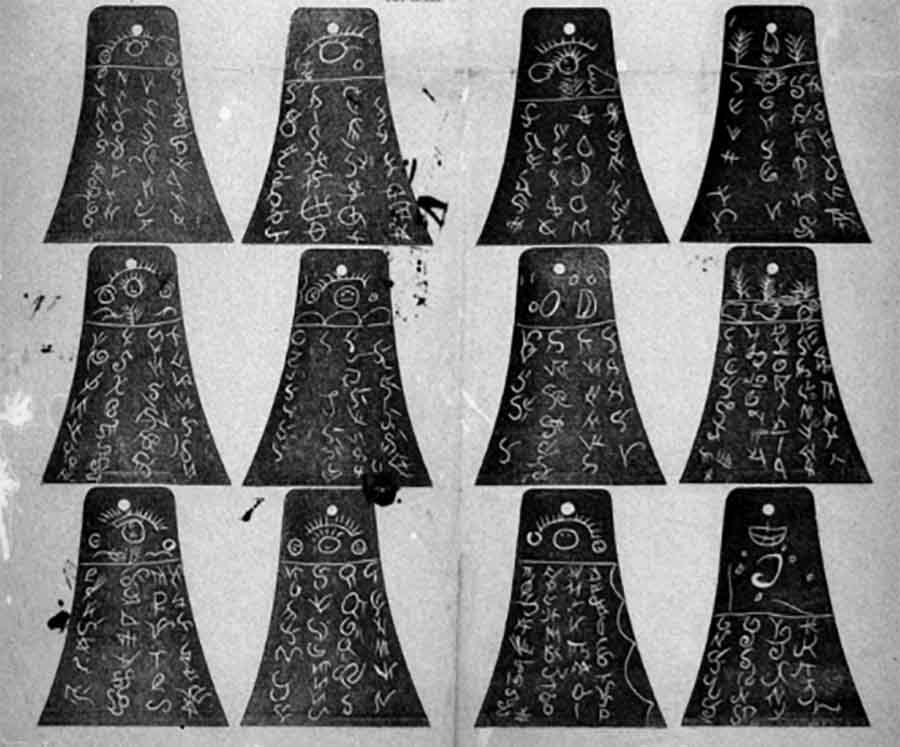
“Only a bogus prophet translates bogus plates”1 That is the claim that has become a mantra for critics regarding the Kinderhook plates. A careful examination of history suggests however, that perhaps such a mantra may be overconfident.
The Kinderhook Plates were indeed a 19th-century hoax which attempted to expose Joseph Smith’s perceived inability as a translator of ancient records.2 A plan which backfired against the fraudsters and actually validates the credibility of Joseph Smith.
In April 1843, six small brass bell-shaped plates covered with mysterious symbols were allegedly unearthed near Kinderhook, Illinois, and brought to Joseph Smith for examination.3 The plates were presented as ancient artifacts, with claims they were found in an Indigenous burial mound alongside a large skeleton.
The plates were presented to Joseph Smith who appears to have initially expressed some level of excitement and even made an attempt to begin translation.

On May 1, 1843 William Clayton, the personal secretary of Joseph Smith wrote:
“I have seen 6 brass plates […] covered with ancient characters of language containing from 30 to 40 on each side of the plates. Prest J. [Joseph Smith] has translated a portion and says they contain the history of the person with whom they were found and he was a descendant of Ham through the loins of Pharaoh king of Egypt, and that he received his kingdom from the ruler of heaven and earth.”4
In History of the church, Brother Clayton wrote in first person as though Joseph Smith, writing:
“I have translated a portion of [the plates] and find they contain the history of the person with whom they were found. He was a descendant of Ham, through the loins of Pharaoh, king of Egypt, and that he received his kingdom from the ruler of heaven and earth.”5
The Nauvoo Neighbor (a Latter-day Saint publication) initially speculated the plates could validate the authenticity of the Book of Mormon and promised a full translation would be published in The Times and Seasons (the official newspaper of the church at that time) once completed. 45.
Discrepancies and Later Revelations
Critics later revealed the plates were a forgery created by local residents to test Smith’s translation abilities12. In 1980, metallurgical analysis confirmed the plates were 19th-century creations, with chemical etching used to produce the symbols 27. Notably, the History of the Church attributed a first-person translation claim to Joseph Smith, but scholars argue this was likely a later editorial insertion based on Clayton’s journal, which was not uncommon for Clayton to do 45.The LDS Church acknowledged the hoax in 1981 78.
Ambiguities in Smith’s Involvement
“Did Joseph fall for the hoax? Not quite. He briefly gave these artifacts due consideration, but did not try to acquire them, retain them, or ultimately find them of any value.” (“What Do the Kinderhook Plates Reveal About Joseph Smith’s Gift of Translation?” Scripture Central, KnoWhy #454, 21 Aug. 2019, https://scripturecentral.org/knowhy/what-do-the-kinderhook-plates-reveal-about-joseph-smiths-gift-of-translation.)
Joseph Smith never claimed to have translated the Kinderhook plates via revelation 4. Non-Mormon witness Sylvester Emmons noted Smith used his Egyptian materials to analyze the plates, suggesting a scholarly rather than revelatory approach17. There is no evidence that Joseph Smith spent any time attempting to translate the plates other than the initial lookover upon receiving them.
After his initial secular approach to the Kinderhook plates, evidence suggests he was skeptical about their authenticity. In a letter to James Cobb, the perpetrator of the hoax, Wilburn Fugate wrote: “We understand Jo Smith said they would make a book of 1200 pages but he would not agree to translate them until they were sent to the Antiquarian society at Philadelphia, France, and England.” Here we not only see evidence that a translation had not taken place but also that he likely questioned their authenticity. The claim of “1200 pages” is likely an embellishment, as the surface area and number of characters are significantly less than the Nephite plates reportedly had. The first edition of the Book of Mormon had only 592 pages.
“Joseph Smith did not make the hoped-for translation. In fact, no evidence exists that he manifested any further interest in the plates after early examination of them…” (Kimball, Stanley B. “Kinderhook Plates Brought to Joseph Smith Appear to Be a Nineteenth-Century Hoax.” Ensign, Aug. 1981).
Additionally, no complete translation was ever published 16. Faithful saints and critics of Joseph Smith agree that Joseph Smith used a secular means of translating rather than claiming divine revelation.
How the Kinderhook Plates Hoax Validates Joseph Smith
This event took place near the 14th anniversary of the day Joseph Smith learned that a prerequisite to revelatory experiences is to first “study it out in [his] mind” (D&C 9:8). This prerequisite appears to be the only effort Joseph Smith put into translating these plates.
The “portion” of the plates Joseph Smith translated was but a single “boat-shaped” symbol.

It appears Joseph Smith compared one symbol on the plates to a glyph in his Grammar and Alphabet of the Egyptian Language (GAEL), a manuscript linked to his translation of the Book of Abraham78.
The GAEL entry for the glyph “Ha e oop hah” describes a figure with “kingly power by the line of Pharaoh” and “possession by birth”8. This aligns with William Clayton’s journal entry stating Smith translated a portion of the plates as referencing a “descendant of Ham through the loins of Pharaoh”26.
The specific symbol Smith linked to Ham’s lineage through Pharaoh was likely a coincidental match to the GAEL’s pre-existing interpretation.
The Kinderhook Plates’ “language” was a fabrication, yet Joseph Smith correctly identified the Ham-related symbol, stemming from a comparison to his earlier Egyptian studies.
Joseph Smith correctly translated the only portion of the plates he claimed to translate! By mere coincidence, the fraudsters, as they were etching fake symbols on the kinderhook plates, accidentally etched a real Egyptian hieroglyph, which Joseph Smith correctly translated, and referred to his grammar book to provide more context to the symbol, which was also accurate. The attempt to translate the Kinderhook plates via revelation never occurred. In retrospect, it’s clear why: the plates were not authentic ancient artifacts. God would not provide a revelation to translate fraudulent texts.
While some critics point to this incident as proof of Joseph Smith’s fraudulent practices, the historical record indicates a more nuanced narrative. Unlike his previous encounters with the Egyptian papyri, which had prompted immediate translation efforts, Smith did not pursue the Kinderhook plates. He neither attempted to purchase them nor engaged scribes to decode their contents, suggesting a marked departure from his typical approach to potential historical artifacts.
The episode reflects a deliberate trap by detractors, akin to the lost 116 pages incident, rather than a failure of Smith’s prophetic gifts16. “The Kinderhook story reminds us that the gifts of the Spirit are not to be used to satisfy the idle curiosities of man.” (“What Do the Kinderhook Plates Reveal About Joseph Smith’s Gift of Translation?”
Scripture Central, KnoWhy #454, 21 Aug. 2019, https://scripturecentral.org/knowhy/what-do-the-kinderhook-plates-reveal-about-joseph-smiths-gift-of-translation.)


- Attributed to Charles A. Shook in a personal letter to James D. Bales
- James D. Bales, The Book of Mormon?, (1958) pp. 98-99
- .
- .
- https://www.josephsmithpapers.org/paper-summary/journal-december-1842-june-1844-book-2-10-march-1843-14-july-1843/203
- History of the Church. Vol. 5. LDS Church. p. 372